
Remember when Amazon’s “1-Click” felt like the pinnacle of convenience? We thought we’d reached the end of the road for e-commerce efficiency. But in reality consumers were still doing the work: scrolling through endless variations, reconciling conflicting reviews, and making the final call. Agentic Commerce removes that burden. The "1-Click" era is giving way to a "No-Click" paradigm where AI completes the journey.
From finding to delegating
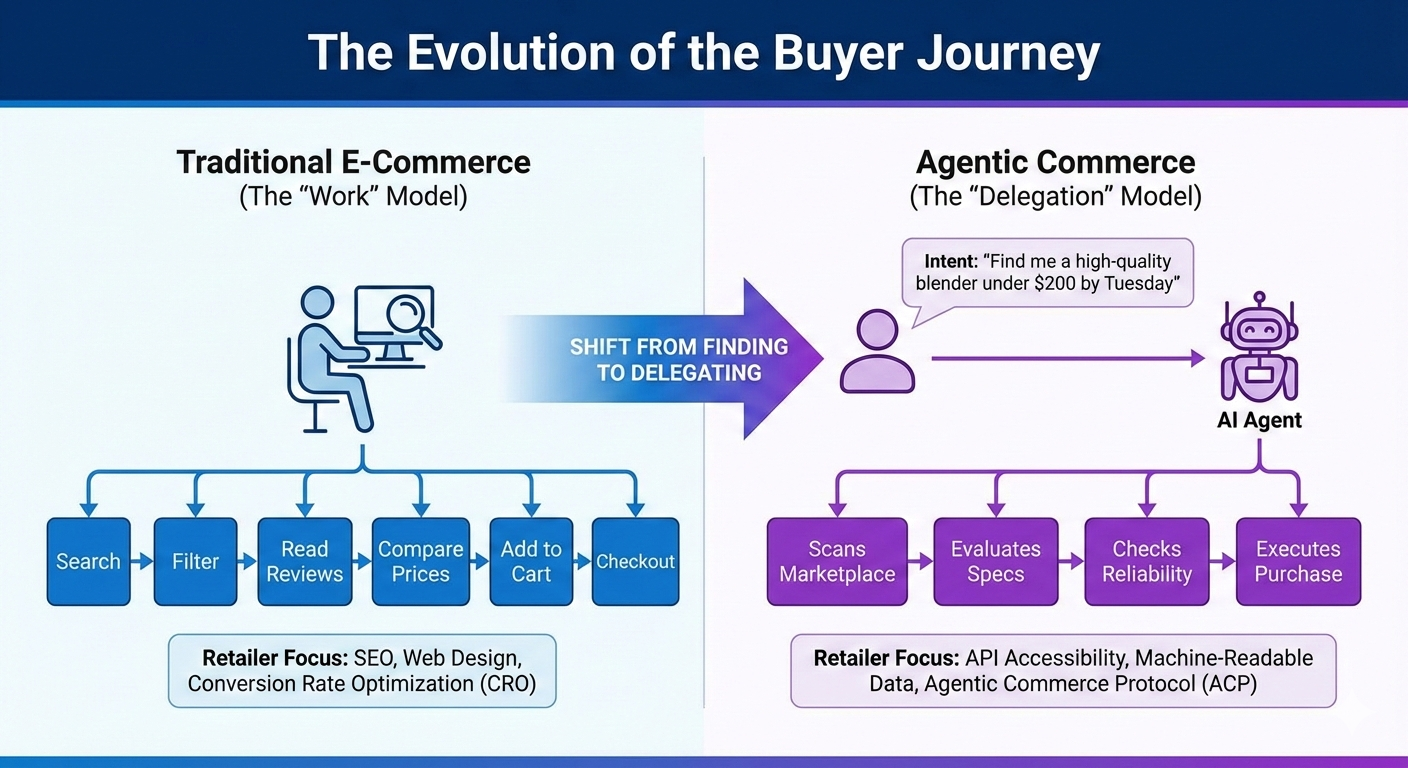
For two decades digital commerce has been anchored in a search-and-find dance. You start with a query, land on a retailer, sift through options, and ultimately pay. According to fresh research from BCG and McKinsey, the discovery phase is being swallowed by AI aggregators like ChatGPT, Claude, and Perplexity. We’re moving from tools that answer questions to agents that execute tasks. They negotiate price, check your calendar for delivery, and press “buy.”
The $385B opportunity
Morgan Stanley projects that agentic commerce could unlock a $385B market by 2030. The driver is agentic substitution: AI doesn’t just help humans shop, it replaces decision-making along the funnel. Visa’s data shows that 46% of consumers already trust AI recommendations more than suggestions from a friend. Demand is outrunning infrastructure.
The evolution of the buyer journey
The evaluation game
The shift introduces a strategic paradox. BCG frames it as the tension between the Destination Game and the Evaluation Game. Destination is about convincing humans to land on your property. Evaluation is about positioning your product so an AI agent selects it sight unseen. If you are not optimized for machines you are invisible to the humans they influence.
Why this matters now
State-of-the-art models such as Gemini 2.0, Claude 3.5, and GPT-5 are acing "economic dominance" tests. They are resistent to shiny banners or false scarcity timers. They respond only to structured data, trustworthy specs, and verified review signals. The "buy" button is moving out of your storefront and into the pockets of autonomous agents.
The question is simple: Is your business ready to sell to a robot?
Consumer trust snapshot
- 46% trust AI recommendations more than a friend for purchase advice.
- 60% have already used AI to assist in a shopping task.
- 54% say they would abandon an agent if they lost control of their data (foreshadowing Chapter 3’s Trust Paradox).